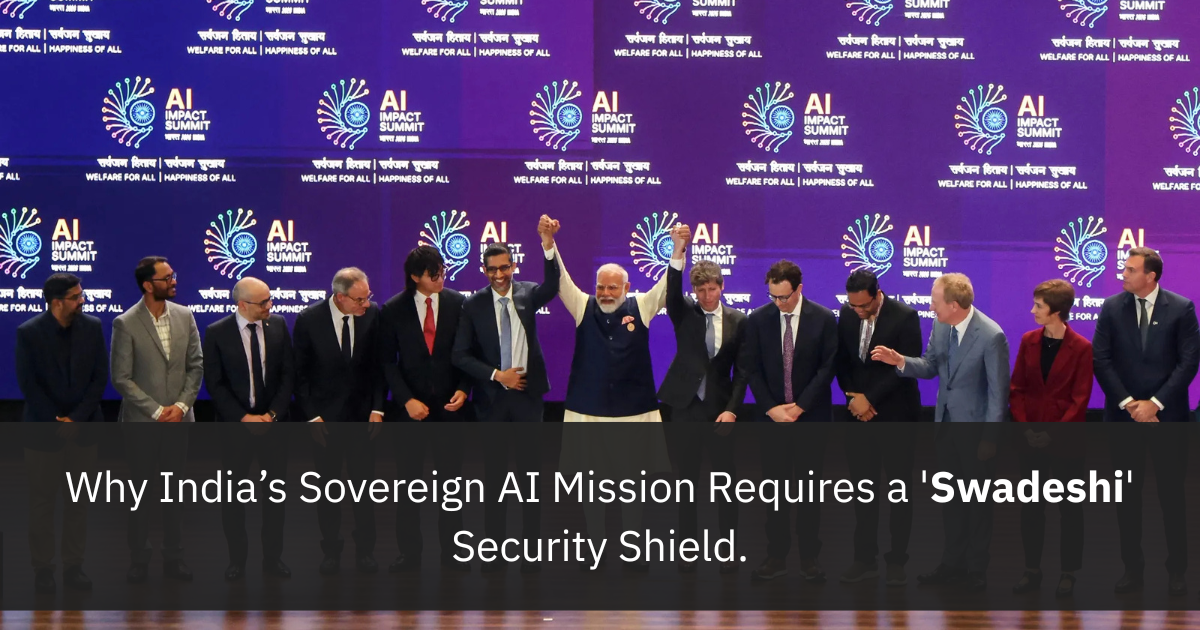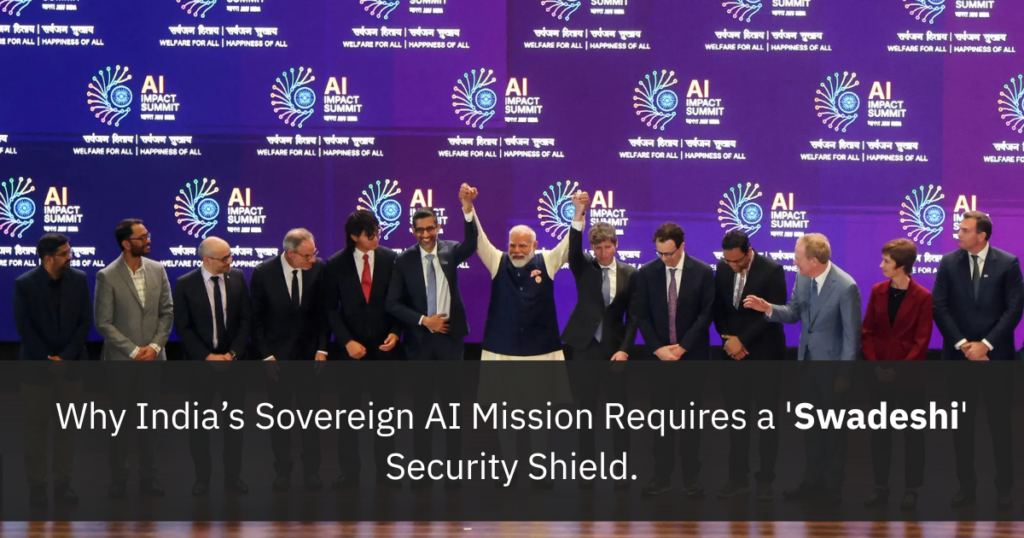
India’s push for sovereign AI has gained unprecedented global spotlight following the India AI Impact Summit 2026, a landmark event held from February 16–20 at Bharat Mandapam in New Delhi. Inaugurated by Prime Minister Narendra Modi, this first-ever major AI summit hosted in the Global South drew over 250,000 participants, heads of state, and leaders from frontier AI companies including OpenAI’s Sam Altman, Anthropic’s Dario Amodei, Google’s Sundar Pichai, and others.
Amid announcements of massive investments exceeding $200 billion in pledges for AI infrastructure—and the unveiling of the New Delhi Frontier AI Impact Commitments, the summit highlighted India’s ambition to lead in responsible, inclusive AI.
It showcased indigenous innovations, with companies like Sarvam AI and Soket AI presenting multilingual models tailored for Indian contexts, reinforcing the nation’s commitment to data sovereignty and equitable technology under the IndiaAI Mission.
The summit served as a powerful platform to transition global AI discourse from safety and governance to tangible impact, particularly for developing nations.
It emphasized democratizing AI benefits across sectors like healthcare, agriculture, education, and public services while addressing risks through collaborative, human-centric approaches.
This momentum aligns perfectly with India’s strategic leap toward technological self-reliance, where homegrown foundation models large language models (LLMs) and smaller variants are being developed to capture the country’s linguistic diversity, cultural nuances, and national priorities.
Companies such as Sarvam AI and Soket AI stand at the forefront of this movement, building models trained on domestic compute infrastructure to ensure data remains under Indian control.
Sarvam AI, a Bengaluru-based startup, has emerged as a leader in this space. It offers a full-stack sovereign AI platform, including frontier-class models like the recently launched Sarvam-105B and Sarvam-30B, which use advanced mixture-of-experts architectures.
These models support multiple Indian languages, excel in reasoning, coding, and multimodal tasks (such as vision and speech), and were trained from scratch using local resources. Backed by substantial support under the IndiaAI Mission including ₹246.72 crore in funding and compute Sarvam focuses on population-scale applications for governance, enterprises, and public services.
Its ecosystem includes tools like voice interfaces, document processing, and even edge deployments for feature phones and smart devices.
Similarly, Soket AI is advancing India’s open-source frontier with ambitious projects like Project EKΛ, aiming for a 120 billion parameter foundational model optimized for linguistic diversity.
It has already released models like Pragna-1B, supporting languages such as Hindi, Gujarati, Bangla, and English, in collaboration with partners like Google Cloud. Soket’s emphasis on ethical, equitable AI aligns with national goals of inclusivity and global competitiveness.
These efforts address a critical gap: India’s vast population speaks dozens of languages, and generic foreign models often underperform on local nuances, scripts, and contexts.
By building indigenous models, India reduces dependency on external providers and fosters innovation in sectors like healthcare, agriculture, education, and e-governance.
The Key Hook: Why India’s Sovereign AI Mission Requires a ‘Swadeshi’ Security Shield
While developing indigenous models is essential, true sovereignty demands more than just model creation. It requires securing the entire AI stack from data ingestion and training to inference and deployment with indigenous security measures.
Relying on foreign cybersecurity tools to protect homegrown AI introduces vulnerabilities that undermine the very purpose of sovereignty.
Data is the lifeblood of AI. Training foundation models involves massive datasets, often including sensitive government records, citizen information, financial details, health data, and proprietary enterprise knowledge.
When processed or stored using foreign cloud services or security solutions, this data risks exfiltration through backdoors, compelled disclosures under foreign laws (such as the U.S. CLOUD Act), or subtle telemetry leaks embedded in proprietary software.
Foreign AI platforms and security vendors may log queries, retain metadata, or access training data for their own improvements practices that conflict with India’s data protection laws and national security imperatives.
In a geopolitical landscape where AI is increasingly weaponized, depending on overseas cybersecurity could expose critical infrastructure to foreign influence, espionage, or sudden service restrictions.
As an Indian cybersecurity company, Haltdos champions the “Swadeshi” approach to protection.
Haltdos delivers unified Web Application Firewall (WAF), DDoS mitigation, and load balancing solutions entirely developed and operated in India. Its patented, AI-powered technologies detect and neutralize threats in real time, ensuring zero-day defense without relying on foreign codebases or cloud dependencies.
Haltdos emphasizes data sovereignty: All processing and logging occur within Indian jurisdiction, eliminating risks of cross-border data flows.
This is particularly vital for AI deployments handling classified or personal data. Unlike global vendors, Haltdos designs solutions tailored to Indian enterprises, SMBs, and government entities—offering affordability, rapid response, and compliance with local regulations like the Digital Personal Data Protection Act.
For sovereign AI stacks, Haltdos provides layered defense:
- Application-layer protection against prompt injection, data poisoning, or adversarial attacks targeting LLMs.
- Network-level safeguards to prevent DDoS floods that could disrupt inference servers.
- Multi-cloud and on-prem flexibility to secure hybrid sovereign environments without vendor lock-in.
By pairing indigenous models from Sarvam or Soket with Haltdos security, organizations achieve end-to-end control: Indian data trained on Indian compute, served via Indian platforms, and shielded by Indian cybersecurity.
The risks of foreign security are not hypothetical. Global incidents have shown how supply-chain compromises in security tools can lead to widespread breaches. For India, with ambitions in defense, finance, and critical infrastructure, such dependencies pose existential threats.
A “Swadeshi” security shield ensures resilience, fosters domestic innovation, and builds trust in national AI ecosystems.
India’s sovereign AI journey is about more than technology—it’s about strategic autonomy in a digital world. Models like those from Sarvam and Soket demonstrate India’s capability to innovate at scale.
But without commensurate indigenous security, sovereignty remains incomplete.
Haltdos stands ready as a partner in this mission, proving that Made-in-India cybersecurity can outperform global alternatives while upholding national interests. The time to secure the Swadeshi AI stack is now—before foreign dependencies become irreversible vulnerabilities.
In building a truly sovereign future, India must protect what it creates. A Swadeshi AI demands a Swadeshi shield.