With the rapid rise in web-based attacks such as SQL injection, cross-site scripting (XSS), and DDoS, securing web applications has become a top priority for businesses. A Web Application Firewall (WAF) plays a critical role in protecting applications by filtering and monitoring HTTP/HTTPS traffic. Today, organizations usually choose between two deployment models: Cloud WAF and On-Premise WAF. Each has its own advantages and limitations depending on business needs, scale, and compliance requirements.
What is a Cloud WAF?
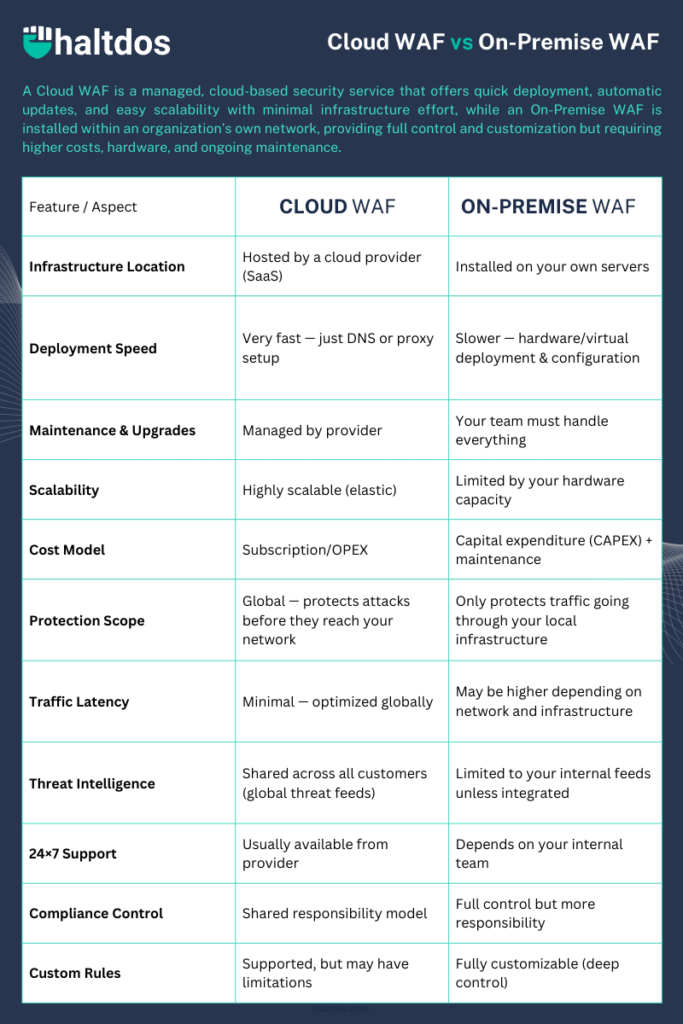
A Cloud WAF is a cloud-delivered security service hosted and managed by a third-party provider. It sits between users and your web application, inspecting traffic before it reaches your servers. Since it operates in the cloud, deployment is fast—often requiring only DNS or reverse-proxy configuration—and updates, threat intelligence, and scaling are handled automatically by the provider.
Key Benefits of Cloud WAF:
- Fast deployment with minimal setup
- Automatic rule updates and threat intelligence
- Easy scalability during traffic spikes
- Lower upfront cost with subscription-based pricing
What is an On-Premise WAF?
An On-Premise WAF is deployed within an organization’s own data center or private cloud. It can be installed as a hardware appliance or virtual machine and gives organizations full control over security policies, traffic flow, and data handling. However, it requires dedicated infrastructure, skilled resources, and ongoing maintenance.
Key Benefits of On-Premise WAF:
- Full control over configuration and data
- High level of customization
- Suitable for strict regulatory and compliance needs
- No dependency on third-party cloud routing
Which WAF Should You Choose?
If your organization values speed, scalability, and ease of management, a Cloud WAF is the ideal choice. It is especially suitable for startups, growing businesses, and public-facing applications. On the other hand, if you operate in a highly regulated environment, require full control over data, or have a dedicated security team, an On-Premise WAF may be more appropriate.
Many enterprises also adopt a hybrid approach, using a Cloud WAF for public traffic while keeping an On-Premise WAF for internal or mission-critical applications.
Conclusion
Both Cloud WAF and On-Premise WAF offer strong protection against web-based threats, but the right choice depends on your business size, security maturity, compliance needs, and operational capabilities. Understanding these differences will help you select a WAF strategy that balances security, performance, and cost effectively.