Introduction
Not every Distributed Denial-of-Service (DDoS) attack attempt to overwhelm a network with massive amounts of traffic. Some attacks operate much closer to the application itself.
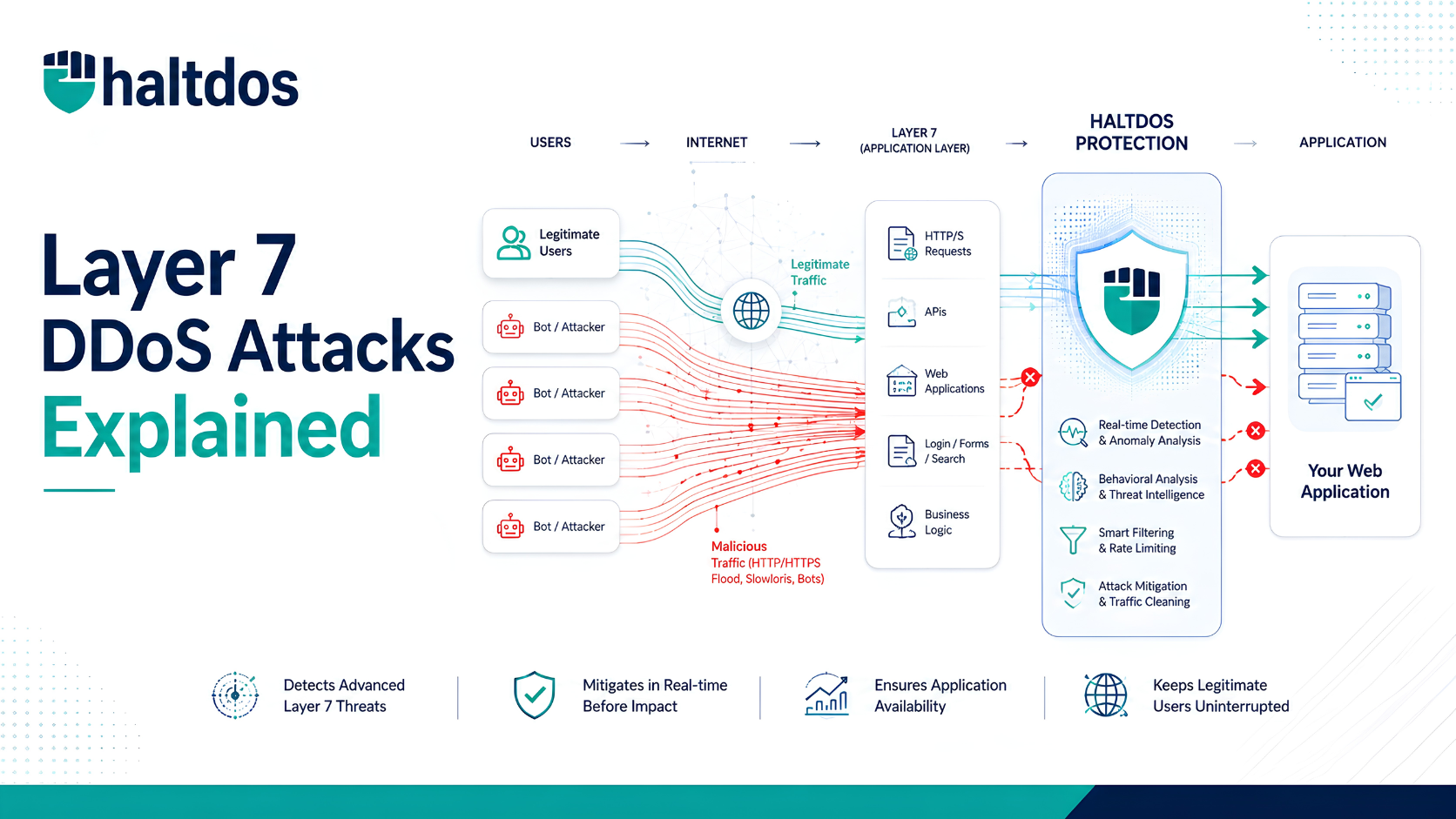
Layer 7 DDoS attacks, also known as Application Layer DDoS attacks, target web applications, APIs, and application resources rather than simply attempting to saturate network bandwidth. Attackers can generate requests that resemble legitimate user activity while consuming resources such as CPU, memory, database connections, application threads, and API capacity. This makes application-layer attacks particularly challenging for security teams.
A Layer 7 DDoS attack is a distributed denial-of-service attack that targets the application layer of the OSI model by overwhelming web applications, APIs, or application resources with malicious requests.
Unlike some high-volume network attacks, a Layer 7 DDoS attack may succeed without generating enough traffic to saturate an organization’s Internet connection. The attacker’s objective is often resource exhaustion rather than bandwidth exhaustion.
For organizations operating customer portals, e-commerce platforms, financial applications, SaaS products, and APIs, effective protection therefore requires visibility into application behavior—not just network traffic volume.
What Is a Layer 7 DDoS Attack?
The OSI model divides network communication into seven layers. Layer 7 is the Application Layer, where protocols and services such as HTTP and HTTPS support communication between users, applications, and servers.
A Layer 7 DDoS attack abuses this application-level communication.
Instead of simply sending large quantities of packets, attackers can generate large numbers of application requests or requests that require significant backend processing.
For example, imagine a normal customer accessing an online banking application.
A legitimate user might:
- Open the login page.
- Authenticate.
- View an account.
- Search for a transaction.
Now imagine thousands of distributed automated clients repeatedly triggering resource-intensive application functions.
The requests may look legitimate at the network level, but the combined workload can consume:
- Web-server resources
- Application-server CPU and memory
- Database connections
- API capacity
- Connection pools
- Authentication infrastructure
- Backend services
As these resources become exhausted, legitimate users may experience slow responses, errors, or complete service disruption.
This is why Layer 7 DDoS protection requires application-aware detection and mitigation.
How Do Layer 7 DDoS Attacks Work?
A typical application-layer DDoS scenario follows a relatively simple defensive model.
- Distributed sources generate traffic: Attack traffic can originate from many compromised or automated systems, making the source population appear distributed.
- Requests reach the application: The clients send HTTP, HTTPS, or API requests to the target application.
- Requests attempt to resemble legitimate activity: Rather than relying exclusively on obviously malicious packets, application-layer attacks can imitate normal browsing or API behavior.
- The application processes the requests: The web server, application logic, authentication system, database, or API backend processes the incoming requests.
- Backend resources become exhausted: Repeated processing consumes resources such as CPU, memory, database connections, and application threads.
- Legitimate users are affected: As application capacity is consumed, legitimate users can experience:
- Increased latency
- Failed requests
- Application errors
- Timeouts
- Reduced availability
The important distinction is that the attacker is targeting application capacity, not necessarily network bandwidth.
Common Types of Layer 7 DDoS Attacks
Layer 7 DDoS attacks can take several forms depending on the application and resources being targeted.
HTTP Floods
An HTTP flood involves large numbers of HTTP requests directed at a web application. Requests may target pages, resources, or application functions that require backend processing. The key challenge is that HTTP requests can resemble legitimate browser traffic. Therefore, simply identifying HTTP traffic as malicious is not sufficient. Security teams need to analyze factors such as request frequency, client behavior, endpoint concentration, session patterns, and other traffic characteristics.
HTTPS Floods
HTTPS protects data in transit through encryption, but encrypted application traffic can make inspection and analysis more complex. An HTTPS DDoS attack can therefore create additional challenges for security infrastructure because traffic must be appropriately inspected while maintaining application performance.
API Flooding
Modern applications increasingly depend on APIs. A single API request can trigger authentication, business logic, database queries, or calls to other services. Consequently, excessive requests against a sensitive API endpoint can create substantial backend workload.
API DDoS protection should therefore consider:
- Request rates
- Endpoint behavior
- Authentication state
- API methods
- Client behavior
- Application context
Cache-Busting Attacks
Applications commonly use caching to reduce backend processing. Attackers may attempt to force requests toward dynamic or uncached resources, increasing the amount of work performed by origin infrastructure.
Slow HTTP Attacks
Some application-layer attacks attempt to keep connections or requests active for extended periods. These attacks can consume connection-related resources even when the overall traffic volume is relatively low.
Application Resource Exhaustion
Attackers may also target functions that require significant computation or backend processing. Examples can include resource-intensive searches, authentication workflows, database-driven functions, or other dynamic application operations.
The important defensive principle is to identify which application functions consume disproportionate resources and protect those functions accordingly.
Layer 7 vs Layer 3/4 DDoS Attacks
Layer 7 attacks differ significantly from traditional network and transport-layer DDoS attacks.
| Characteristic | Layer 3/4 DDoS | Layer 7 DDoS |
| OSI layer | Network / Transport | Application |
| Primary target | Network or transport resources | Application resources |
| Typical protocols | IP, TCP, UDP | HTTP, HTTPS, APIs |
| Main objective | Consume network or protocol capacity | Exhaust application/backend resources |
| Traffic volume | Often high | Can be relatively low |
| Application awareness | Limited | High |
| Detection complexity | Generally more network-oriented | Often more behavior-oriented |
| Example attacks | UDP floods, SYN floods | HTTP floods, API flooding, slow HTTP attacks |
| Typical mitigation | Network filtering, traffic scrubbing, protocol controls | WAF, rate limiting, bot management, behavioral analysis, DDoS protection |
Organizations should not treat these categories as mutually exclusive.
A sophisticated attack campaign can involve multiple layers simultaneously. Effective DDoS protection should therefore consider both network-level and application-level threats.
Why Are Layer 7 DDoS Attacks Difficult to Detect?
They Can Look Like Legitimate Traffic: A malicious HTTP request may look very similar to a request generated by a genuine user. This makes traditional IP-based blocking less effective in some scenarios.
They May Use Lower Traffic Volumes: Layer 7 attacks do not necessarily require enormous bandwidth. An attacker may instead focus on generating requests that create a disproportionate workload on the application.
They Can Target Specific Endpoints: Rather than targeting an entire website equally, an attacker can concentrate traffic against specific application functions. This can make the attack less obvious when looking only at aggregate traffic volume.
HTTPS Encrypts Traffic: Encrypted traffic can complicate inspection and analysis, particularly when organizations need to distinguish legitimate users from automated or malicious clients.
Distributed Sources Make Simple Blocking Difficult: When traffic originates from many sources, blocking individual IP addresses may provide only temporary or limited protection. Modern detection therefore benefits from analyzing behavior and multiple traffic signals simultaneously.
Signs of a Layer 7 DDoS Attack
Security and infrastructure teams should monitor combinations of unusual application and infrastructure behavior.
Potential indicators include:
- Sudden increases in HTTP/HTTPS requests
- Traffic spikes concentrated on specific URLs
- Unusually high API request rates
- Increased application latency
- High CPU utilization
- Memory exhaustion
- Database resource exhaustion
- Increased HTTP error rates
- Unusual session behavior
- Large numbers of automated clients
- Sudden changes in geographic traffic patterns
- Legitimate users reporting slow or failed requests
No individual indicator proves that a Layer 7 DDoS attack is occurring. A better approach is to correlate multiple signals and compare current behavior against established traffic baselines.
How to Detect Layer 7 DDoS Attacks
Effective detection typically combines several sources of information.
- Request-Rate Analysis: Monitor requests per second across applications, users, sessions, IP addresses, and API endpoints.
- Behavioral Analysis: Look for deviations from normal application behavior.
For example, an unusual concentration of requests toward a particular endpoint may be more significant than an overall traffic increase. - IP Reputation: Known malicious or suspicious IP addresses can provide useful context. However, reputation should generally be one signal rather than the sole basis for detection.
- Client Fingerprinting: Fingerprinting can help security teams identify recurring characteristics across clients and detect automated behavior.
- User-Agent Analysis: Unusual or inconsistent user-agent patterns can provide additional indicators of automated traffic.
- Geographic Analysis: Unexpected changes in traffic distribution can help identify anomalies, particularly when combined with other signals.
- Session Analysis: Security teams can examine session duration, request sequences, authentication behavior, and request frequency.
- API Behavior Monitoring: API-specific monitoring is important because application APIs can have different traffic patterns and resource requirements from traditional web pages.
- Bot Detection: Bot detection helps distinguish legitimate automated services from malicious automation.
- Anomaly Detection: Behavioral and anomaly detection techniques can help identify traffic patterns that deviate from established baselines. The strongest detection strategy generally combines these signals rather than relying on a single threshold or rule.
How to Mitigate Layer 7 DDoS Attacks
Layer 7 DDoS mitigation should use multiple complementary controls.
- Rate Limiting: Rate limiting restricts how frequently clients, sessions, or other traffic groups can access application resources. This can help prevent excessive request volumes from consuming application capacity.
- WAF Rules: A Web Application Firewall (WAF) can inspect application traffic and enforce policies designed to identify and block malicious requests. WAF policies are particularly useful when attack traffic contains recognizable characteristics.
- Bot Management: Bot management can identify automated traffic and distinguish suspicious automation from legitimate users and services.
- Behavioral Analysis: Behavioral analysis can identify abnormal request patterns that may not match a predefined signature. This is especially useful for attacks that attempt to resemble normal application traffic.
- Challenges: CAPTCHA, JavaScript, or other verification challenges can be selectively applied when suspicious automated behavior is detected. Challenges should be used carefully because excessive challenges can negatively affect legitimate users.
- CDN and Edge Protection: Filtering traffic closer to the network edge can reduce the amount of malicious traffic reaching origin infrastructure.
- Dedicated DDoS Protection: Dedicated DDoS protection provides another defensive layer for detecting and mitigating DDoS traffic before it overwhelms critical infrastructure.
- API Security: API-specific controls such as authentication, rate limiting, endpoint monitoring, and behavioral analysis are important when APIs are targeted.
- Autoscaling: Autoscaling can help applications accommodate legitimate demand spikes. However, scaling should not be considered a standalone DDoS defense. Automatically adding infrastructure can become expensive if malicious requests continue to consume resources.
Can a WAF Stop Layer 7 DDoS Attacks?
A WAF can help mitigate many Layer 7 DDoS attacks, but a WAF alone should not be considered comprehensive protection for every application-layer DDoS scenario.
A WAF can inspect HTTP and HTTPS requests and enforce security policies. It can also support controls such as rate limiting, custom rules, bot mitigation, and traffic filtering.
However, sophisticated Layer 7 attacks may involve:
- Distributed automated traffic
- API abuse
- Low-and-slow behavior
- Resource-intensive application functions
- Legitimate-looking requests
- Multiple attack patterns simultaneously
This is why organizations increasingly consider a broader Web Application and API Protection (WAAP) strategy.
A WAAP architecture can combine:
- WAF
- DDoS protection
- API security
- Bot management
- Rate limiting
- Behavioral analysis
- Traffic intelligence
The objective is not simply to block malicious requests, but to protect the entire application delivery path.
How Does WAAP Help Against Layer 7 DDoS?
WAAP, or Web Application and API Protection, extends traditional WAF capabilities by bringing multiple application security controls together. This broader approach is valuable for Layer 7 DDoS defense because application-layer attacks can cross multiple security domains.
For example, an attack may involve suspicious automation against an API while simultaneously generating requests against web applications.
A WAAP platform can bring together:
- Application-aware traffic inspection
- WAF policies
- API visibility
- Bot detection
- Rate limiting
- Behavioral analysis
- DDoS mitigation
- Automated threat detection
This creates a more coordinated defense strategy than relying on a single security control. Importantly, WAAP is not simply another name for WAF. WAF is one component of the broader application and API protection model.
How Haltdos Helps Protect Against Layer 7 DDoS Attacks
Haltdos provides a practical example of the broader application-security approach to DDoS protection. Its current platform combines DDoS protection, WAF/WAAP, API security, and anti-bot capabilities, allowing organizations to address application-layer threats through multiple controls.
Haltdos documentation describes its cloud WAF service as providing built-in protection against Layer 7 DDoS attacks using controls such as threshold-based limiting, Geo-IP filtering, automated bot detection and mitigation, JavaScript challenges, cryptographic challenges, and traffic analysis.
Its current technical specifications also identify protection against volumetric and Low & Slow Layer 7 DDoS attacks, alongside API security capabilities including authentication, rate limiting, API discovery, and protection against API-related security risks.
The Haltdos WAF platform also supports application and API protection, custom rate-limit rules for DDoS protection, and advanced bot mitigation. This layered approach matters because application-layer DDoS attacks rarely fit into a single category.
A security architecture may need to identify:
- Excessive request rates
- Automated clients
- Suspicious application behavior
- API abuse
- Malicious request patterns
- Volumetric DDoS traffic
- Low-and-slow application attacks
Rather than depending solely on bandwidth-based mitigation, combining these capabilities provides visibility into both traffic volume and application behavior.
Layer 7 DDoS Protection Best Practices
Organizations protecting modern applications and APIs should consider the following checklist:
- Establish normal traffic baselines.
- Monitor application traffic continuously.
- Protect APIs separately and explicitly.
- Implement sensible rate limits.
- Use bot detection and management.
- Deploy WAF policies.
- Use dedicated DDoS mitigation where appropriate.
- Monitor application and backend performance.
- Protect resource-intensive endpoints.
- Monitor database and connection-pool utilization.
- Maintain DDoS incident-response procedures.
- Test security controls regularly.
- Use layered security instead of relying on one control.
The goal should be to prevent malicious traffic from consuming application resources while minimizing disruption to legitimate users.
Layer 7 DDoS Attack Example
Consider a fictional financial service application. The organization notices a sudden increase in requests to its login and account-search APIs. The traffic originates from thousands of distributed sources and resembles normal browser activity. Network bandwidth remains within normal limits, but application CPU usage and database utilization begin approaching capacity.
Security teams investigate several indicators:
- API request rates
- Session behavior
- Client characteristics
- Geographic distribution
- Request concentration
- Application latency
- Database utilization
The organization identifies abnormal automated behavior and applies several defensive controls. Suspicious clients are rate-limited, automated traffic is challenged, API protections are enforced, and DDoS mitigation is activated where necessary. The result is a layered response rather than a simple IP-blocking exercise. This illustrates an important characteristic of Layer 7 DDoS attacks:
The network may remain operational while the application itself is approaching failure.
Layer 7 DDoS vs Traditional DDoS: Quick Comparison
The distinction can be summarized simply:
- Layer 3/4 DDoS attacks primarily target network and transport resources.
- Layer 7 DDoS attacks target application and backend resources.
- Layer 7 attacks can resemble legitimate user traffic.
- They do not always require massive bandwidth.
- API endpoints can be attractive targets.
- WAF, bot management, API security, rate limiting, and DDoS protection can work together.
- Application behavior is an important part of detection.
For modern organizations, protecting only the network perimeter is therefore insufficient. Applications and APIs need their own security controls.
Conclusion
Layer 7 DDoS attacks represent a different challenge from traditional high-volume network attacks.
Instead of simply overwhelming bandwidth, attackers can target the resources that make applications work—web servers, APIs, databases, authentication systems, application logic, and connection pools. The most difficult attacks can resemble legitimate traffic, making simple IP blocking or bandwidth monitoring insufficient.
Effective web application DDoS protection therefore requires a layered strategy involving:
- WAF protection
- DDoS mitigation
- API security
- Bot management
- Rate limiting
- Behavioral analysis
- Application monitoring
- Traffic intelligence
WAAP brings many of these capabilities together into a broader application-security strategy. Platforms such as Haltdos demonstrate this approach by combining DDoS protection with WAF/WAAP, API security, and bot-management capabilities.
The key takeaway is simple:
Layer 7 DDoS attacks are difficult because they target application behavior and can resemble legitimate traffic. Effective defense requires application-aware, behavioral, and layered security controls.