Choosing a Web Application and API Protection (WAAP) platform usually starts as a security conversation and ends as an infrastructure compromise. Most vendors support one or two deployment models well, and everything else becomes a workaround — a proxy in front of the appliance, a separate cloud SKU with a different rule engine, or a migration project nobody budgeted for.
Haltdos WAAP was built to remove that trade-off. The same detection engine, policy framework, and management console deploy across hardware, virtual machines, Kubernetes, MSSP environments, and SaaS — so the infrastructure decision and the security decision stay separate, the way they should be.
Why WAAP Deployment Flexibility Matters
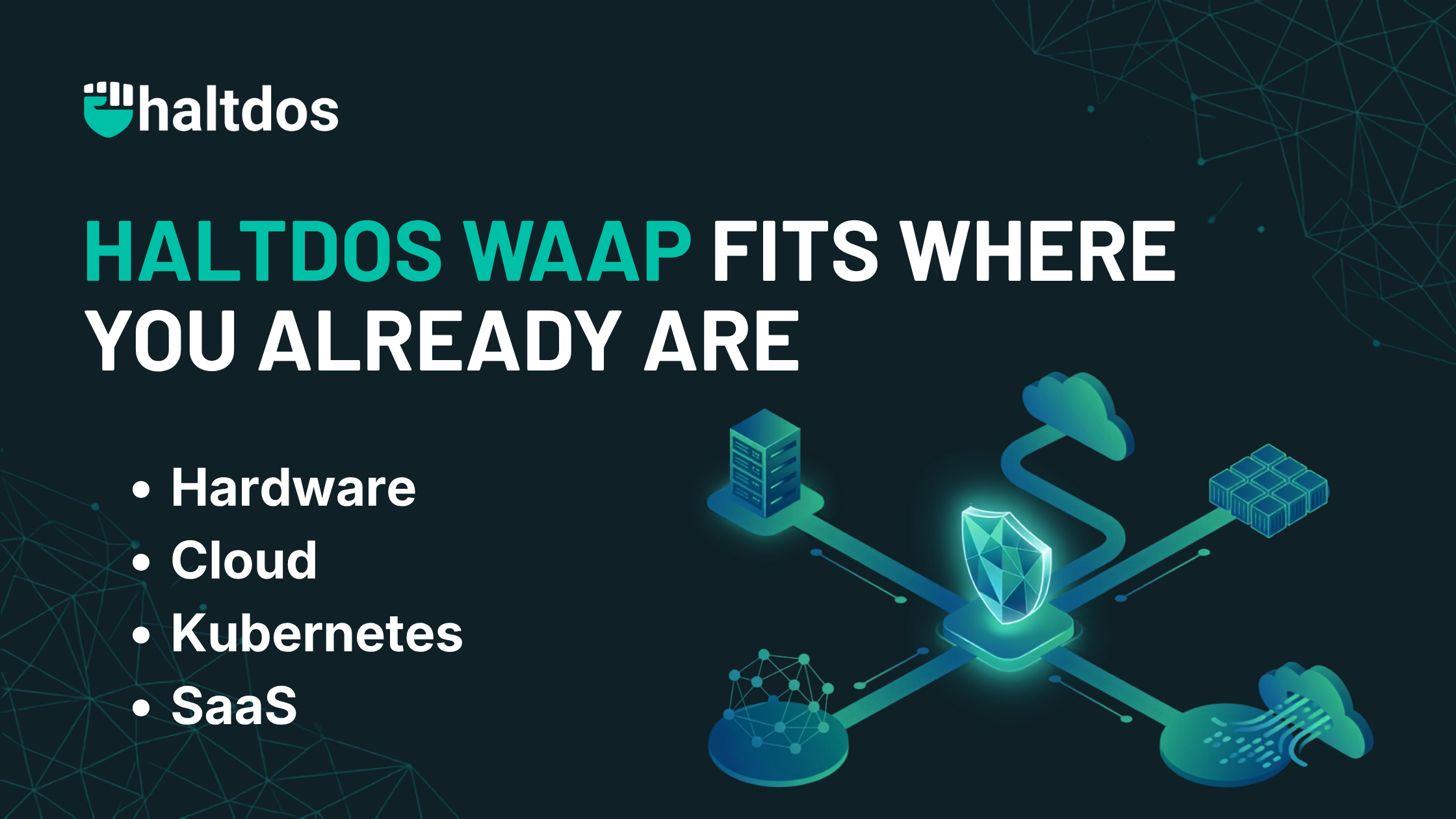
Enterprise environments are rarely one thing. A typical mid-to-large organization today runs some mix of:
- Legacy applications on-prem or in a private data center
- Newer workloads on VMs in a private or hybrid cloud
- Microservices and APIs running in Kubernetes
- Some functions outsourced to an MSSP
- A push toward SaaS wherever infrastructure ownership isn’t a priority
A WAF/WAAP vendor that only does cloud SaaS leaves the on-prem estate exposed or forces a redesign. A vendor that only ships hardware appliances can’t follow workloads into Kubernetes. When protection is inconsistent across environments, so is the security posture — attackers only need to find the one part of the stack running an older, weaker, or missing control.
How Haltdos WAAP Deploys Across Every Model
Hardware The HD-SFT appliance line is built for data-center-grade performance — L4 throughput scaling from 5 Gbps up to 120 Gbps and WAF/L7 throughput up to 100 Gbps depending on model, with sub-millisecond induced latency and a built-in TPM chip and hardware HSM for SSL offload. This is the option for latency-sensitive, high-traffic, or regulatory environments that require dedicated on-prem control.
Hardware The HD-SFT appliance line is built for data-center-grade performance — L4 throughput scaling from 5 Gbps up to 120 Gbps and WAF/L7 throughput up to 100 Gbps depending on model, with sub-millisecond induced latency and a built-in TPM chip and hardware HSM for SSL offload. This is the option for latency-sensitive, high-traffic, or regulatory environments that require dedicated on-prem control.
VM / Containers The same policy and detection engine runs virtualized for private and hybrid cloud, scaling resources up or down with traffic rather than requiring a hardware refresh.
Kubernetes For cloud-native applications, Haltdos WAAP protects microservices and APIs at the pace they’re deployed, without sitting as a bottleneck in the CI/CD pipeline.
MSSP Managed security providers can deliver Haltdos WAAP to their own client base under centralized, multi-tenant management — one platform, many customers, without standing up separate infrastructure for each.
SaaS For teams that want protection without infrastructure overhead, Haltdos WAAP is available fully managed and cloud-delivered, live in minutes. Organizations that want to evaluate the core WAF engine first can also start with the free Haltdos Community WAF.
Why That Makes Haltdos a Stronger Option Than Most WAAP Vendors
Deployment flexibility is only useful if the protection behind it is consistent and complete. A few things set Haltdos apart from a typical single-mode or cloud-only WAAP vendor:
No forced re-architecture. Many vendors require migrating traffic to their cloud or replacing existing infrastructure to get full protection. Haltdos protects the infrastructure you already have, in the model you already run it in.
One policy engine everywhere. Security teams write and manage one rule set, one set of dashboards, and one incident workflow — instead of reconciling different WAF logic across a hardware box in one data center and a cloud SKU in another.
Depth of coverage, not just perimeter blocking. Haltdos combines OWASP Top 10, OWASP Top 20 Automated Threats, and SANS 25 coverage with 4,000+ built-in signatures, AI-driven zero-day protection through automatic application profiling, and a built-in API gateway that validates JSON, XML, GraphQL, REST, and WebSocket traffic — going beyond basic signature matching that many lower-tier WAF products stop at.
Bot and fraud defense built in, not bolted on. Advanced device fingerprinting, a mobile SDK for Android/iOS app protection, CAPTCHA/JS challenges, and deception technology to trap and profile attackers are part of the core platform rather than a separate add-on module.
DDoS protection in the same platform. L3–L7 DDoS protection against both volumetric and low-and-slow attacks ships with the WAAP, rather than requiring a separate anti-DDoS product and vendor relationship. Built-in load balancing is included too — see how load balancing paired with a WAF improves both security and uptime in practice.
Compliance reporting out of the box. PCI DSS, HIPAA, GDPR, and SOC 2-aligned reporting is built in, reducing the manual work of proving compliance after the fact.
India-based support. 24×7 support with a dedicated account manager and TAC support based in India — relevant for organizations that need support in local time zones and under Indian data-handling expectations.
What This Means for Your Security Strategy
Instead of choosing a WAAP vendor based on which infrastructure model they happen to support, security and infrastructure teams can choose based on what should actually drive the decision — detection quality, breadth of protection, compliance coverage, and support — and deploy it wherever the environment calls for it, today or after the next migration.
That’s the difference between buying a point product and buying a security platform built to move with the business.
Frequently Asked Questions
Web Application and API Protection (WAAP) extends traditional WAF capabilities with API security, bot management, and DDoS protection in a single platform. Read the full breakdown in the Haltdos WAF guide.
Yes. The same policy engine and detection logic run across hardware, VM, Kubernetes, MSSP, and SaaS deployments, so hybrid environments get consistent protection without separate rule sets per model.
Yes. Haltdos WAAP includes built-in reporting aligned to PCI DSS, HIPAA, GDPR, and SOC 2 requirements.
Ready to see how Haltdos WAAP fits your environment?
Explore the full feature set and request a demo: Haltdos Enterprise WAAP